


I guess it was bound to happen sooner or later. Last week, in no uncertain terms, my daughter, Emily, told me that I was cut off. Done. Finished…
…No longer would I be permitted to borrow her iPod when I went to the gym.
First of all, according to Emily, I was “getting it all sweaty.” Second, and much less disgustingly, I was “running down the battery life,” a phenomenon which was apparently wreaking havoc on her finely tuned listening schedule. And while I considered pointing out that she had been running down my battery life for the previous 12 years, I had to admit that Emily had a point.
So the next day, I went out and bought an iPod of my own – a tiny, blue (of course) iPod Shuffle. It holds about 250 songs, and over the last several days I’ve been busy filling it up with my 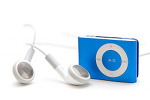 favorites.
The Shuffle is the least expensive iPod available – it has no screen and the songs are played randomly. It’s this randomness, in fact, which gave me the most pause before purchasing.
I was concerned that one unrelated song after another would be annoying (or at least distracting), and I thought about getting one of the more expensive models which lets you play songs by artist, genre, or groups you create on your own, such as, “Songs I can’t believe my daughter listens to.”
In the end, I decided to buy the Shuffle, randomness and all. And now, having lived with it for about a week, it actually turns out that the randomness of the song presentation is what I enjoy most.
I’ve got Sheryl Crow, followed by Randy Newman, followed by Amy Winehouse, followed by, well, you get the picture. No rhyme or reason, just one great song after another, all day long; the fact that each song is unrelated to the one before actually keeps things kind of interesting.
If you ask me, “No rhyme or reason, just one great song after another, all day long,” is about the best formula there is for ordering newsletter topics.
Here’s what I mean…
Lots of companies – and in my experience, the larger the company, the more this seems to be the case – go to great pains to create a “logical” editorial calendar. The thinking is that by putting things in the proper order, they’ll best be able to get their message across and share their expertise.
This un-random strategy, however, has at least two problems with it.
1. Your readers couldn’t care less.
Most subscribers most of the time will have almost zero memory of what you wrote about last month. That doesn’t mean they won’t form an impression of you, they just don’t remember the details.
And while they might remember a bit of a story here or a snippet of advice there, for the most part, and to the extent they remember anything, it will appear random to them. So hashing out the perfect calendar is a waste of your time.
2. It will limit your ability to choose today’s best topic.
The best topic for today is the one that is most compelling today. Not the next thing on the list, but rather the thing that is most top of mind, most burning, for you, the thought leader in your field. If you plan your topics ahead of time, you’ll miss the relevancy of the moment – and relevant moments are what make your newsletter come alive.
As a practical matter, therefore, my recommendation is that you keep a list somewhere – in a Word document, on a whiteboard, in your notebook – of potential future topics. Anytime you have an idea (or even a piece of one), put it down in your, as that great E-Newsletter writer Winnie the Pooh might say, Topic Place. Then, each month, open up your list and grab the one that grabs you.
One more thing. If all this randomness is troubling to your sense of order and sound business practices, keep in mind that your newsletter isn’t a marketing campaign or even a presentation that you give to a group of listeners.
It’s a relationship… a proxy for the lunch that you (as a practical matter) can’t have with each of your readers every month. And just as you don’t plan what you’re going to say or eat or wear at your next 12 lunches (and if you do, I’d rather you not get in touch with me), you’re better off not planning your next year’s worth of newsletter “conversations” either.
Bottom Line: As someone once said, “A happy life is just a string of happy moments.” By the same token, a successful E-Newsletter is just a string of really good ones. Push the “random button” on your topic choices, let yourself off the planning hook and simply pick the most relevant, most interesting, most pressing topic you can think of each time your write. Emily and I look forward to reading it.
– Michael
| About Michael Katz www.BluePenguinDevelopment.com Related Resources More Posts by Michael Katz To discover the easy and inexpensive ways anyone can attract more clients and maximize their profits, sign up for your FREE Profit Now Report. |
![Reblog this post [with Zemanta]](http://img.zemanta.com/reblog_e.png?x-id=a29b5b55-176d-4ff8-9939-3c4a2057c65a)

February 17th, 2010 at 2:20 am
Hello-
Greetings from the island of Bali-
this is my first visit… and i really love your articles..
i think i can get more lessons here.. thanks for sharing.
February 17th, 2010 at 2:59 pm
Good points, particularly your last one with regards to relevant content. Understanding what your customer wants to read and delivering that to them is key to building a relationship. It shows you care about them, more than about your newsletter schedule. It also gives you the flexibility to be current, especially if you operate in a fast moving market such as technology, for example.
February 21st, 2010 at 7:24 am
Hi, I loved this entry! I have a site with a creativity side (spoken word, poetry, stories) and an idea side (good thinking on all kinds of topics). I’ve been encouraged by a couple of friends to separate my email list (about 10,000) – or at least write all on an idea or a creative piece. Another close friend likes it as it is.
You are giving me the best reasons to keep things as they are. When ideas are uppermost – go with ideas but still give space to some creative piece. When some creative piece is uppermost, go with that, but also give space to ideas.
Thank you. Elsa